
When the Transaction Feels Risky: A Case Study of Using Rabby Wallet for Multi‑Chain DeFi from an Archive Landing Page
Imagine you’re on a Saturday morning in Boston, reading about a new DeFi yield strategy in a Telegram group. The protocol lives on Ethereum and an optimistic rollup; the UI asks you to approve a series of token approvals and a contract call. You’ve used MetaMask for years, but this interaction looks fiddly: multiple chains, a complex allowance, and a contract with an unfamiliar name. Do you click “confirm” and hope for the best, or do you take a minute to simulate and inspect the transaction first?
This article follows that exact decision path using Rabby Wallet as the practical case. The goal is to give a clear operational mental model for an experienced but non‑specialist US reader: how Rabby approaches multi‑chain DeFi, what security and UX trade‑offs matter, where the design improves on common alternatives, and what limits still require caution. If you want the archived installer and a PDF overview while you read this, the rabby wallet PDF linked below is the same document many users land on from mirrors and archival pages.
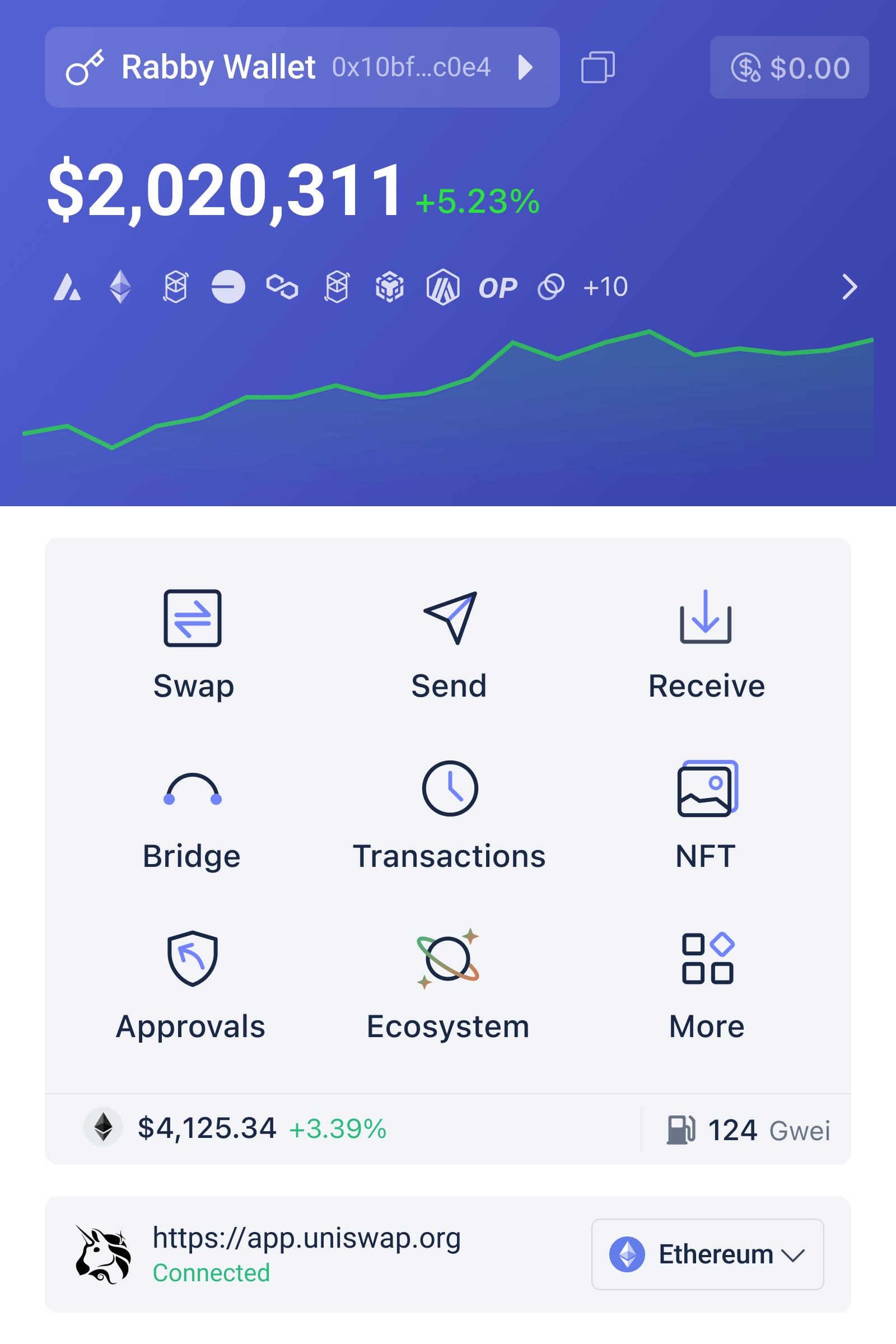
Concrete scenario: A multi‑chain swap with cross‑chain approvals
Start with the action: you connect your browser extension to a DEX aggregator that routes a swap across two chains (Ethereum mainnet and an optimistic rollup). The dApp asks for an ERC‑20 approval, then a cross‑chain bridge call, then the final swap on the destination chain. In a standard wallet flow this often becomes three separate confirmations, a confusing nonce sequence, and a single UI that hides fees and slippage details.
Rabby’s practical contribution — and the mechanism behind its value proposition — is threefold. First, pre‑transaction security analysis surfaces suspicious patterns (e.g., arbitrary contract approvals or token sweeps) before you hit “confirm.” Second, transaction simulation estimates effects and gas before submission so you can see whether the call would revert or succeed under current state. Third, multi‑chain UX groups accounts, networks, and pending transactions cleanly so users are less likely to approve a transaction on the wrong chain. Each of these mechanisms addresses a specific failure mode that power users often face.
How Rabby works, mechanistically
At the implementation level, the wallet is a browser extension that manages private keys locally, similar to other browser wallets. Where it diverges is in its foregrounded analysis: before broadcasting a transaction Rabby runs heuristics and simulations against a node or a light provider to predict outcome and flag risky contract calls. It also provides clearer UI affordances for contract approvals — for instance, differentiating “allowance to spend exactly X” from “unlimited allowance” and making the target contract address and token visible in the same panel.
Transaction simulation is not magic: it runs the proposed transaction on a read‑only replica of chain state to see whether it would revert and to estimate gas and post‑transaction balances. This can catch common errors (incorrect slippage settings, failed bridge verifications) but it cannot predict front‑running or state changes that occur between simulation and broadcast. Similarly, heuristics for “suspicious” behavior rely on known patterns — like large token drains or approvals to newly created contracts — but they are subject to false positives and false negatives. Understanding these boundaries is crucial in practice.
Myths vs reality: What Rabby fixes and what it doesn’t
Myth: “A second wallet with more features equals bulletproof security.” Reality: tools like Rabby reduce cognitive load and surface risks, but they do not change the fundamental trust model. A browser extension still holds your private keys locally and still interacts with remote smart contracts. If you approve a malicious contract because you misunderstood its function, Rabby’s warnings may help but won’t stop a confirmed malicious transaction from executing.
Myth: “Simulations eliminate gas and reversion risk.” Reality: simulation reduces uncertainty by showing a likely outcome, but it cannot guarantee the actual on‑chain result. Network reordering, mempool dynamics, and conditional contract logic that depends on off‑chain state can make the real execution diverge. Put another way: simulation improves decision quality but does not convert risk into certainty.
Trade‑offs and the design choices that matter
There are explicit trade‑offs in prioritizing power‑user features. Rich transaction analysis requires more permissions and access to provider nodes to run reliable simulations; this increases the attack surface if the extension or its data channels are compromised. Streamlined multi‑chain UX requires the extension to manage multiple network configurations and to surface network switching prompts — an extra place where a user can click the wrong chain. Simplicity versus control is the core tension: the more a wallet automates (e.g., automatic chain switching, gas optimization), the more it removes burden and the more it can mask subtle behaviors. The right balance depends on the user’s risk tolerance and technical sophistication.
For US users this balance has regulatory and practical implications. Compliance regimes and tax tracking benefit from clearer on‑chain metadata (which Rabby surfaces), but simplified approvals can lead to faster movement of assets that then need reporting. Power users who value granular control will appreciate the additional details; casual users benefit from guided defaults but should remain cautious about approving unlimited allowances or unfamiliar contracts.
For more information, visit rabby wallet.
Decision‑useful heuristics for readers
Here are practical, reusable rules you can apply when using Rabby or any advanced browser wallet:
- Always check the target chain and account twice before confirming; Rabby’s multi‑chain UI reduces slip‑ups but does not eliminate them.
- Prefer exact allowances when interacting with new contracts; only use “infinite” allowances for deeply trusted, widely audited contracts and consider setting a reminder to revoke later.
- Use simulation output as a filter, not a guarantee. If simulation fails, do not proceed; if it succeeds, still consider timing risk and mempool conditions.
- When a pre‑tx warning appears, pause and inspect the contract address and the exact function being called. A short address lookup against a reputable explorer can prevent many scams.
Where the approach breaks down — and what to watch next
Two limitations deserve special attention. First, wallets that surface more metadata depend on trustworthy data providers. If the node or simulation endpoint is manipulated, the analysis may be misleading. That’s a systemic risk across all extension wallets that lean on remote services. Second, UX improvements can create a new class of mistakes: overreliance on the extension’s recommendations. Users who stop reading the contract details because the wallet “flags it as safe” will be vulnerable if heuristics fail or adversaries craft transactions that look benign to automated checks.
Signals to monitor: increased integration of off‑chain signatures (e.g., permit patterns) and gas abstraction will change the interaction model; wallets that adapt to simulate these newer flows will be more useful. Also watch whether wallets like Rabby add verifiable, open simulation backends — that reduces trust concentration and makes analysis auditable. Finally, any new public audit or peer review of the wallet’s heuristics would materially improve trust for cautious US users.
FAQ
Is Rabby safer than MetaMask?
“Safer” depends on the threat. Rabby adds pre‑transaction analysis, simulation, and clearer multi‑chain controls, which reduce cognitive mistakes and surface suspicious patterns — valuable when interacting with complex DeFi flows. But both are browser extensions holding private keys locally; neither removes the fundamental risk of approving a malicious contract. Use Rabby’s features to improve decision quality, not to replace scrutiny.
Can transaction simulation prevent losing funds?
Simulation lowers the chance of an unexpected revert or obvious state change, but it cannot prevent all losses. It won’t eliminate frontrunning, oracle manipulation, or attacks that exploit race conditions. Treat simulation as a diagnostic: if it shows a problematic outcome, stop; if it looks clean, you have better information but not certainty.
Should I use Rabby for every DeFi interaction?
Rabby is particularly helpful for power‑user scenarios: cross‑chain flows, complex approvals, and when you need deeper transaction visibility. For routine transfers, simpler wallets work fine. The useful heuristic: match tool complexity to task complexity — use Rabby when the transaction has multiple steps, unfamiliar contracts, or cross‑chain components.
To explore the extension directly and download the archived installer and documentation used by many readers, see the rabby wallet PDF hosted in the archive link above.
Final takeaway: Rabby is a useful evolution in the browser‑wallet category because it foregrounds mechanisms (simulation, pre‑tx analysis, multi‑chain organization) that address concrete user failure modes. Those mechanisms shift the decision burden toward better informed choices, but they do not remove the need for user judgment, conservative allowances, and independent contract inspection. For US users managing taxable or regulated exposures, that final bit of human oversight remains the most important control.
